
History of origin
As early as the 14th century, there are written reports of at least two organs in Hildesheim Cathedral: the main organ and a so-called small organ. These organs were rebuilt or modernised according to the taste of the time by important organ builders such as Matthias Naumann from Hildesheim (a master journeyman of Arp Schnitger) in the Baroque period and Furtwängler & Hammer from Hanover at the beginning of the 20th century.
After the Second World War, the cathedral only had one organ on the newly built west gallery. This organ was built by Franz Breil from Dorsten in 1960 and was the first Catholic cathedral organ with purely mechanical action in Germany. The façade was designed by the Hanoverian architect Heinz Wolff and the neo-baroque specification was put together by Rudolf Reuter from Münster. In 1989, on the initiative of the then cathedral organist Fritz Soddemann, the Klais workshop in Bonn completely rebuilt this organ behind the old façade and added a swell to the specification. This state of affairs continued until 2010.
The decision by the Hildesheim cathedral chapter to demolish the old organ gallery as part of the cathedral's renovation meant that the cathedral choirs now had a different place to sing, which also included a choir organ to accompany them. The main organ was placed in its old position, albeit slightly to the rear and without a protruding choir gallery in front of it. Both organs were commissioned from the Seifert workshop in Kevelaer and designed and planned by the Schilling architectural office in Cologne in consultation with the commissioned organ builder.
The current specification of both organs was designed by the cathedral musicians. While the choir organ is a completely new construction, many parts of the Breil and Klais organs have been reused in the main organ: including 58 stops, almost all of the old windchests and the chassis of the main console. The choir organ provides all the tone colours for a viable, romantically oriented choral accompaniment, while the main organ is based on the Klais organ in terms of its sound concept, but has been renewed or supplemented in the area of the headmaster stops, the bass stops and the solo voices. The sound colours in the swell of the choir organ can also be used in conjunction with the main organ as a kind of remote organ. The entire organ system can be played from two identical 4-manual consoles. The main console at the top has mechanical action, while the general console in the nave is purely electric. The control works via a BUS system.
Annual figures and events
- around 1360: First written reports of organs in Hildesheim Cathedral (main organ, so-called small organ, organ in the crypt)
- Probably in the 14th century Replacement of the main organ by an unknown organ builder
- 1571: Construction of a new main organ by Cornelius and Michael Slegel
- 1616/17: New construction of the main organ by Henning Henke, completed by Conrad Abtt (III+additional pedal/38 stops)
- 1682/83: Remodelling of the main organ by Tobias Bader II, reduction to two manuals and installation of an independent 16' pedal division (II+pedal/32 stops)
- 1703 - 1706: New construction by Matthias Naumann (III+Ped./41 stops)
- 1713: Sale of the small organ to Steinbrück
- 1744: Relocation of an organ by Johann Georg Müller from St. Godehard to the crypt of the cathedral as a replacement for the lost shelf (I+adj. Ped./8 stops)
- 1862: Construction of a new organ for the crypt by August Schaper (I+Ped./8 stops)
- 1909: Construction of a new main organ by Furtwängler & Hammer behind the old façade (III+Ped./54 stops)
- 1930: Sale of the crypt organ to the parish of St Joseph in Hildesheim
- 1945: Destruction of the main organ by bombing on 22 March
- 1960: Construction of a new main organ by organ builder Breil (IV+Ped./52)
- 1981: Use of a chest organ by Orgelbau Hillebrand in the crypt (I/4 stops)
- 1989: Remodelling and extension (including installation of a swell) of the main organ by organ builder Klais behind the old façade (IV+Ped./66 stops)
- 2010 Relocation of the chest organ from the crypt to the chapel of the Episcopal Vicariate General
- 2010 Removal and storage of the main organ
- 2013/14 Conversion and extension of the main organ and construction of a new choir organ by Orgelbau Seifert (IV+Ped./77 and II+Ped./16)
- 2015: The cathedral has a five-stop chest organ made by Fay (Braunschweig), which is used in concert as a continuo instrument and on Sundays as an accompanying instrument in the crypt (vespers).
The cathedral organ: change over the course of time
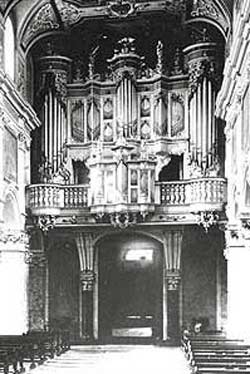
The cathedral organ before 1945
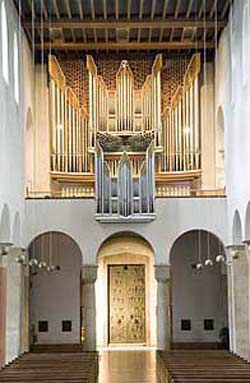
The cathedral organ 2007
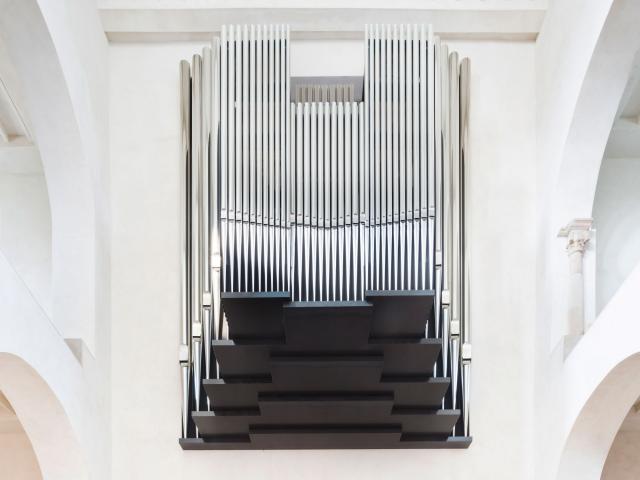
The main organ of Hildesheim Cathedral today
© Manfred Zimmermann/Euromediahouse